



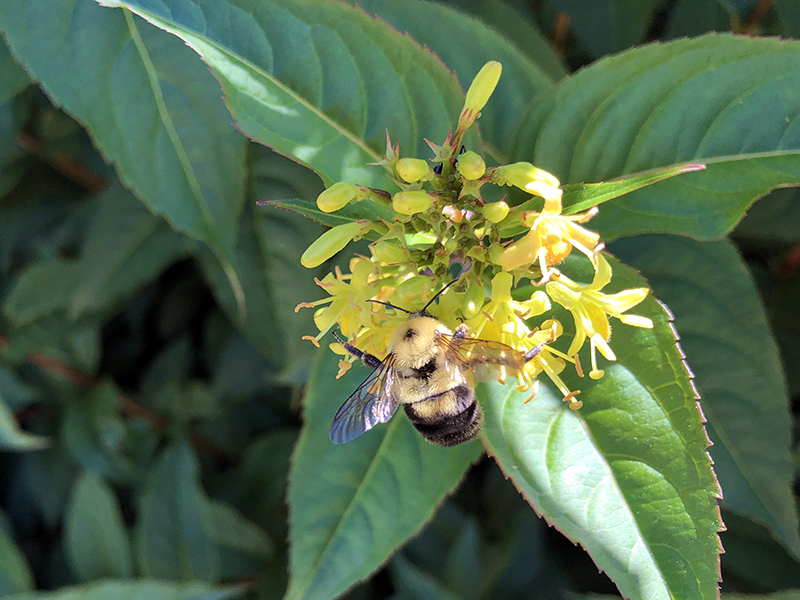
 Northern Bush Honeysuckle (Diervilla lonicera)
Northern bush honeysuckle is a hardy, low-growing native shrub that blooms from late spring into early summer, usually May through June. Its small, tubular yellow flowers appear along arching stems lined with opposite, oval green leaves that often develop reddish or purple tones in fall. Native to the Northeastern United States, including northern New Jersey, this shrub naturally grows in open woodlands, rocky slopes, forest edges, and dry upland sites. The flowers provide nectar for native bees and butterflies, and the plant serves as a host for several moth species. With its spreading root system and tolerance for poor soils, northern bush honeysuckle helps stabilize slopes and supports resilient, low-maintenance landscapes.
Despite its misleading name, northern bush honeysuckle is not related to invasive Asian bush honeysuckles. Some Indigenous communities in eastern North America documented traditional knowledge of native shrub species used for specific practical purposes and land stewardship, reflecting close relationships with forest and woodland plants. This information is shared as historical context rather than guidance.
Note: Northern bush honeysuckle (Diervilla lonicera) is a valuable native alternative to invasive bush honeysuckles such as Lonicera japonica and Lonicera morrowii.