




April 02, 2026| Education, Environment
By: Patrick Krudop
Welcome to another edition of Creature Feature, where we explore the incredible wildlife that calls Lake Hopatcong and the surrounding region home. This week’s feature is in honor of National Wildlife Week, a time dedicated to appreciating the native species we share New Jersey with.
You may recall that fairly recently, we held a poll to see what animal should be spotlighted for World Wildlife Day. Since that day and this week share a similar theme, we thought it was only fair to circle back and give some attention to the runner-up: the barred owl. (Second place is still pretty good.)
The barred owl is a medium-to-large owl, standing about a foot and a half tall with a wingspan of up to four feet. Despite its size, it weighs only around a pound and a half (about the weight of a loaf of bread).
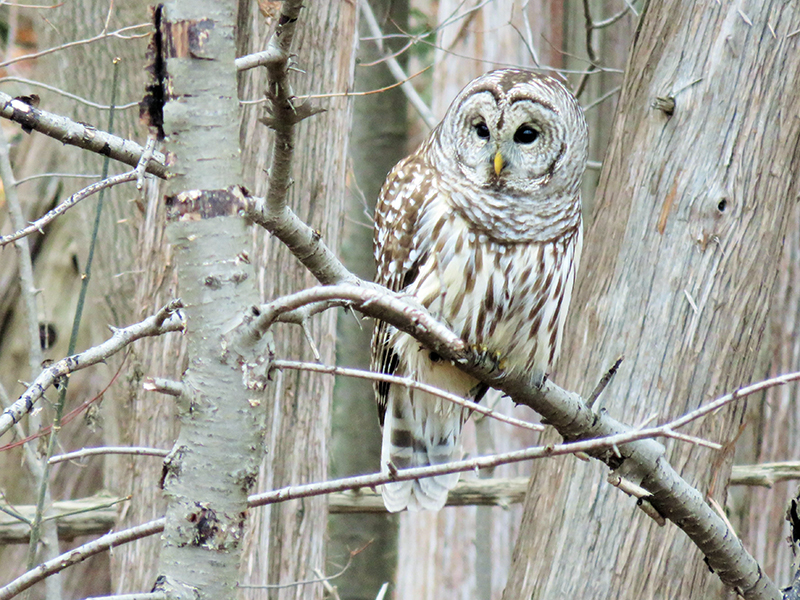
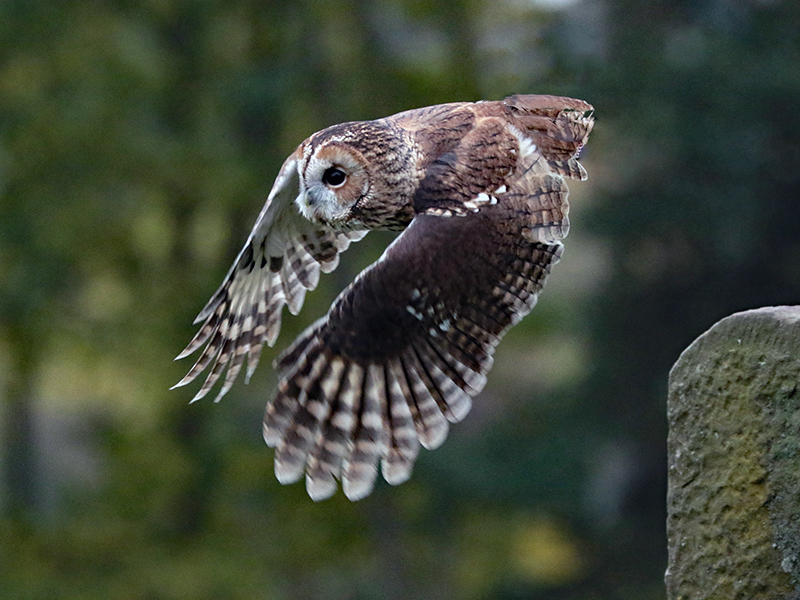
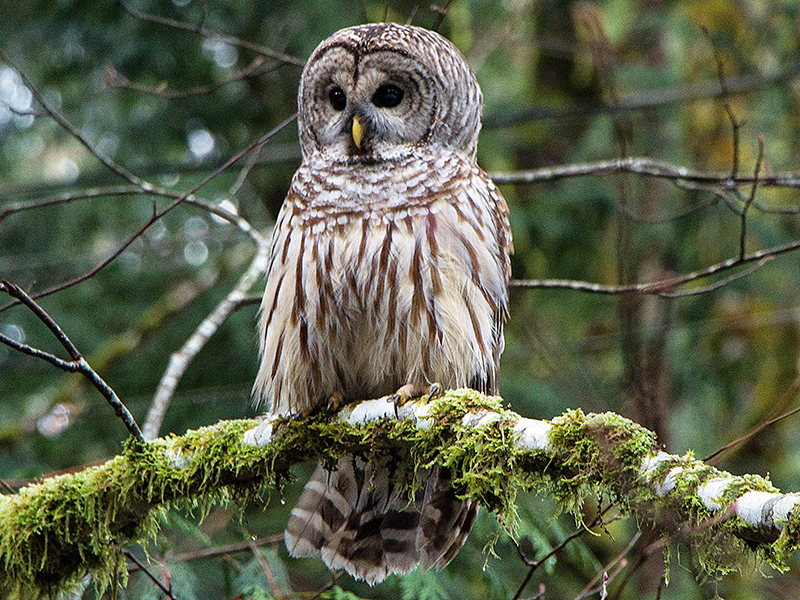
Its plumage is a distinctive mix of brown and white, with horizontal barring across the chest and vertical streaking along the belly. This pattern not only gives the species its name, but also helps it blend seamlessly into the forest.
With its rounded head and dark eyes, the barred owl has a classic owl appearance. However, it is most often identified not by sight, but by sound.
 |
 |
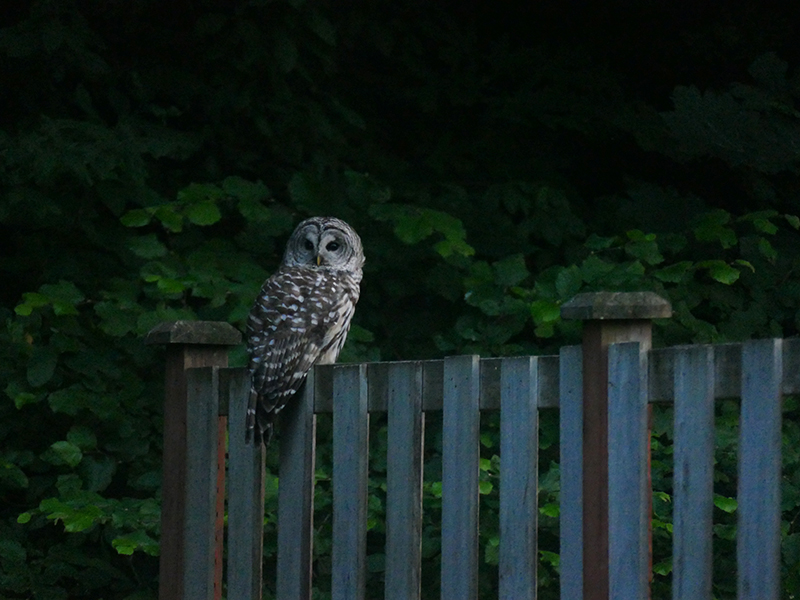
Barred owls are well adapted to staying out of sight. They are primarily active at night and spend much of the day roosting quietly in trees, so most encounters begin with their call rather than a visual sighting.
That call is one of the most recognizable in the region, often described as sounding like, “Who cooks for you? Who cooks for you all?” It is so distinctive that it is often one of the first bird calls a novice birder learns.
Their vocalizations serve several important purposes. Barred owls use them to establish territory, communicate with one another, and attract mates. During the breeding season, pairs may call back and forth, creating a series of echoing calls through the forest.
Around Lake Hopatcong, they are commonly found in wooded areas near water, where their calls carry easily through the landscape, especially in the evening and early morning hours. These sounds are a defining characteristic of the species and one of the easiest ways to recognize their presence.
Barred owls are highly effective predators, relying on a combination of specialized vision and hearing to locate prey in the dark.
To understand the first adaptation, imagine for a moment that I am your eye doctor. Keep your eyes focused on the words you are reading right now, but tilt your chin down… now up… now to the left and right. Notice how your eyes can stay locked on the text even as your head moves around.
Barred owls (and all owls!) cannot do that. Their eyes are fixed in place and cannot move within their sockets. What they lose in eye mobility, however, they make up for with exceptional low-light vision and incredible neck flexibility. This is why owls can rotate their heads up to 270 degrees, allowing them to scan their surroundings without ever moving their eyes.
The second key adaptation is their hearing. Barred owls have asymmetrical ears, meaning one ear is slightly higher than the other. This allows them to detect subtle differences in the timing and direction of sounds, giving them a kind of built-in surround sound system. As a result, they can pinpoint the exact location of prey, even in complete darkness, much more effectively than humans with our symmetrical (and admittedly more aesthetically pleasing) ears.
At Lake Hopatcong and throughout New Jersey, the barred owl is a reminder that wildlife is active even after the sun goes down. Its call is one of the most recognizable nighttime sounds in our region.
The next time you are outdoors in the evening, take a moment to listen. You may hear that familiar call echoing through the trees.
I hope you’ve enjoyed learning about these remarkable birds. Perhaps this article has inspired you to explore nature further—whether through reading, visiting a website, or simply stepping outside! If you have any wildlife photos from Lake Hopatcong, or if there’s a critter you’d like to see featured in an upcoming Creature Feature, please send your submissions to info@lakehopatcongfoundation.org. See you next time!
 |
 |

March 25, 2026
Education, Environment

February 25, 2026
Environment

May 01, 2025
Education, Environment